
Business context
A public signal becomes an outreach opportunity only after relevance, intent, brand safety and the permitted contact path have been reviewed.
Prospective customers often describe a product failure, poor service or unmet need publicly on X. That moment can indicate real buying intent, but it moves quickly and is buried inside a much larger stream of irrelevant conversation.
Manual social listening finds only a small share of the opportunity and response quality varies by person. If the team replies too late, too generically or without context, the moment is lost and the outreach can feel intrusive.
The operating problem
Find genuine frustration, understand the need and respond before the buying window closes.
The system must distinguish a useful demand signal from jokes, news, bot activity, existing support conversations and sensitive personal situations. It also needs a lawful, brand-safe path from a public post to an X response and, only when permitted, a follow-up email.
What the demand-capture agent does
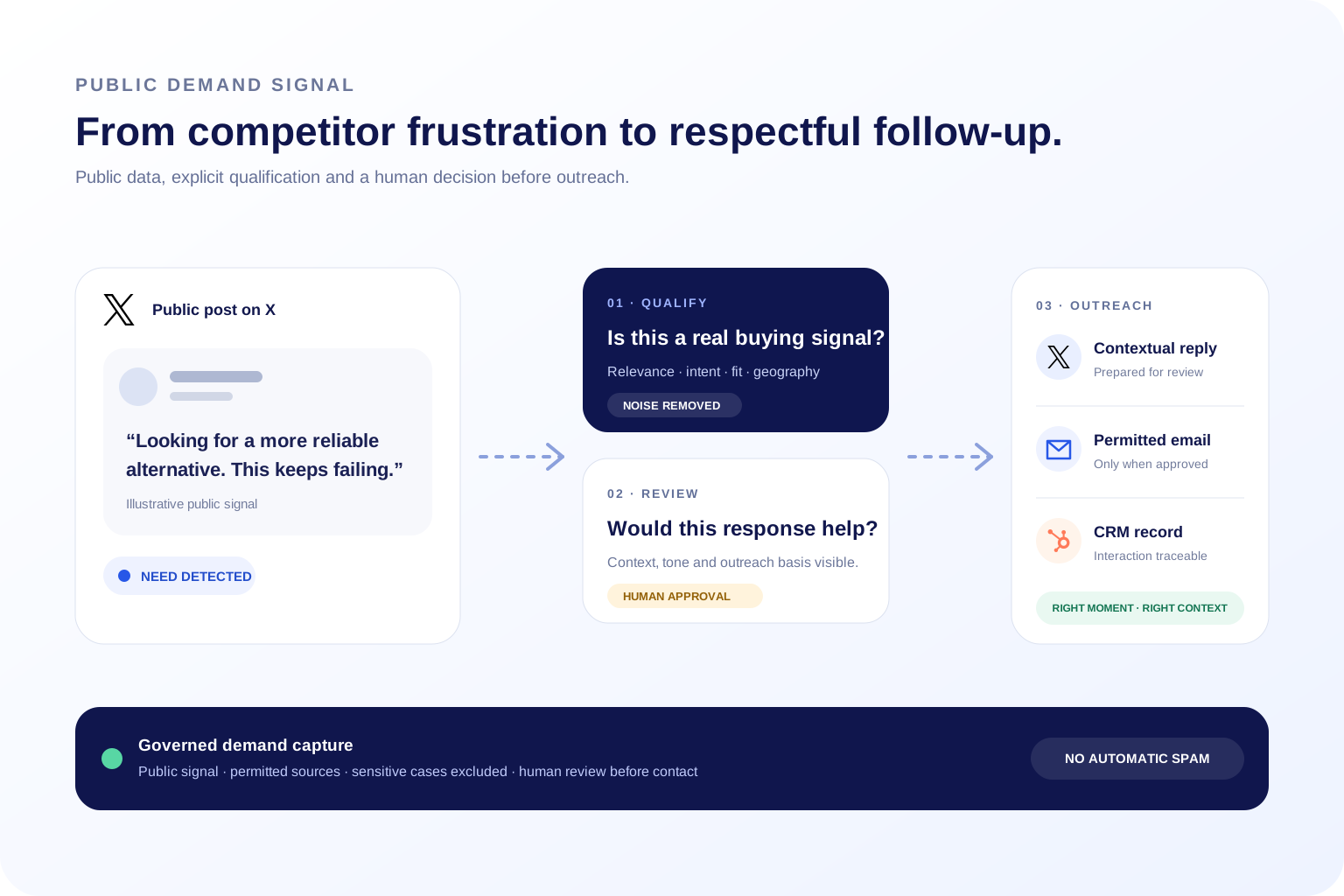
MATTE builds a governed listening and outreach workflow using approved public-data and platform access. The agent prepares context and responses; the business controls who is contacted and what is sent.
01 Listen for public demand signals
The workflow monitors approved competitor, category and problem terms on public X posts through permitted access.
02 Qualify the opportunity
The agent scores relevance, intent, geography and fit, then removes noise, sensitive situations and existing customer-support cases.
03 Prepare a useful response
The agent drafts a contextual X reply or direct outreach that addresses the stated problem without pretending to know more than the public post reveals.
04 Follow up with permission
If a business contact is lawfully available and outreach is permitted, the workflow prepares a relevant email and records the interaction in the CRM.
What changes for the business
Sales receives a smaller stream of timely, high-context opportunities from people already expressing an unmet need. Prospects receive a relevant response at the moment they are evaluating alternatives, not a generic campaign weeks later.
Measure it with: qualified public signals, time to approved response, X reply rate, permitted email response rate, sourced opportunities, opt-outs and complaints.
Controls and ownership
Automation has a boundary.
Use public information and permitted data sources only. Respect X platform rules, privacy law and anti-spam requirements. Do not collect private profile data, infer sensitive traits or send email unless the contact source and outreach basis are approved. Keep outbound messages behind human review until the operating model is proven.
Operating owner: Growth owns the target criteria and offer. Sales or community teams approve engagement, legal defines the outreach rules, and MATTE manages the agent and workflow controls.