Matte Logo
Product

Nerve AI

Nerve overviewRun Meta, Google and TikTok ads from Claude or ChatGPTFeaturesLaunch, optimize, audit and reportHow it worksConnect, ask, review and approve

Use Nerve

ConnectorsNerve inside Claude and ChatGPTSecurity & privacyLive access, no stored campaign dataFor agenciesMany accounts, one working view

Matte builds

Pixel auditFree pixel tracking auditCustom AI agentsPurpose-built agents for your operating modelWorkflowsRecurring work that runs on schedule
Featured product

Stop checking five platforms. Ask one question.

Nerve puts ad operations inside Claude or ChatGPT—with approval before every change.

Explore Nerve →
Solutions

Performance & measurement

Performance optimizationProtect ROAS as spend scalesData & trackingRepair the signals ad platforms learn fromAnalytics & attributionConnect media to revenue

Data & activation

Marketing automationTurn journeys into reliable systemsMMP & mobile analyticsMeasure installs through revenueCustomer data platformsUnify and activate first-party data
Start with the bottleneck

Tell us where revenue or time is leaking.

We will map the technical work to the commercial outcome it should move.

Book discovery call →
Integrations
Resources

Learn

Help centreStraight answers for common tasksUse casesProblems, systems and outcomes

Company

About MATTEBuilt inside a performance marketing ecosystemIndustriesSystems adapted to the way your business sellsContactTalk through your stack and priorities
Operator library

See the work behind better ROAS.

Each use case connects a marketing problem to the system that solves it.

Explore use cases →
Pricing
Book a callStart Nerve free

Manual ad work is slowing your growth. MATTE takes it off your plate

Explore how Nerve, custom AI agents and governed AI workflows can solve recurring problems across campaign operations, measurement, demand capture and reporting.

Use Cases

Filter by challenge
Thank you! Your submission has been received!
Oops! Something went wrong while submitting the form.

Run marketing performance conversations inside WhatsApp

Combine business and media data behind an always-on WhatsApp assistant that answers follow-up questions in plain language.
Read More
run-marketing-performance-conversations-inside-whatsapp

Business context

The validated data model stays behind the experience while leadership asks performance questions in the channel it already uses.

A business leader wants to understand revenue, media spend, campaign movement and operational exceptions without opening dashboards or waiting for a weekly report. WhatsApp is already where the leadership team communicates and makes decisions.

Traditional reporting still asks the decision-maker to find the right dashboard, understand the filters and interpret the result. Static reports answer the first question but create another round of messages when leadership wants to know why something changed.

The operating problem

Move from scheduled reporting to a two-way performance conversation.

The assistant must combine commerce, analytics, CRM and paid-media data without creating another version of the truth. It needs to answer follow-up questions, explain data limitations and keep access appropriate for each WhatsApp user.

What the WhatsApp performance agent does

MATTE builds the data workflow, metric layer and conversational agent together. WhatsApp becomes the interface, while the validated data model remains behind it.

01 Connect the operating data

Approved media, GA4, commerce, CRM and finance sources feed a scheduled and monitored data workflow.

02 Apply shared business definitions

Revenue, spend, ROAS, acquisition cost and other KPIs follow documented currency, date and attribution rules.

03 Deliver the active summary

The assistant sends scheduled performance updates, material exceptions and the business context leadership has agreed to receive.

04 Answer follow-up questions

Authorized users ask what changed, why it matters and which owner is responding, without opening a dashboard or requesting another spreadsheet.

What changes for the business

Leadership gets an always-available marketing performance assistant in the channel it already uses. There is no dashboard to check, no sheet to maintain and no report to wait for as the primary experience, while the underlying data remains governed and traceable.

Measure it with: time from question to answer, active leadership users, follow-up questions resolved, recurring report preparation time, data exceptions and decisions assigned through the assistant.

Controls and ownership

Automation has a boundary.

Only approved users and phone numbers can access the assistant. Answers follow the governed metric layer, identify the reporting period and disclose missing or delayed sources. Campaign changes require a separate action and approval flow.

Operating owner: Marketing operations owns the metric definitions and delivery schedule. Leadership owns the decisions, source-system owners resolve data failures, and MATTE can manage the workflow and agent.

Reporting and intelligence

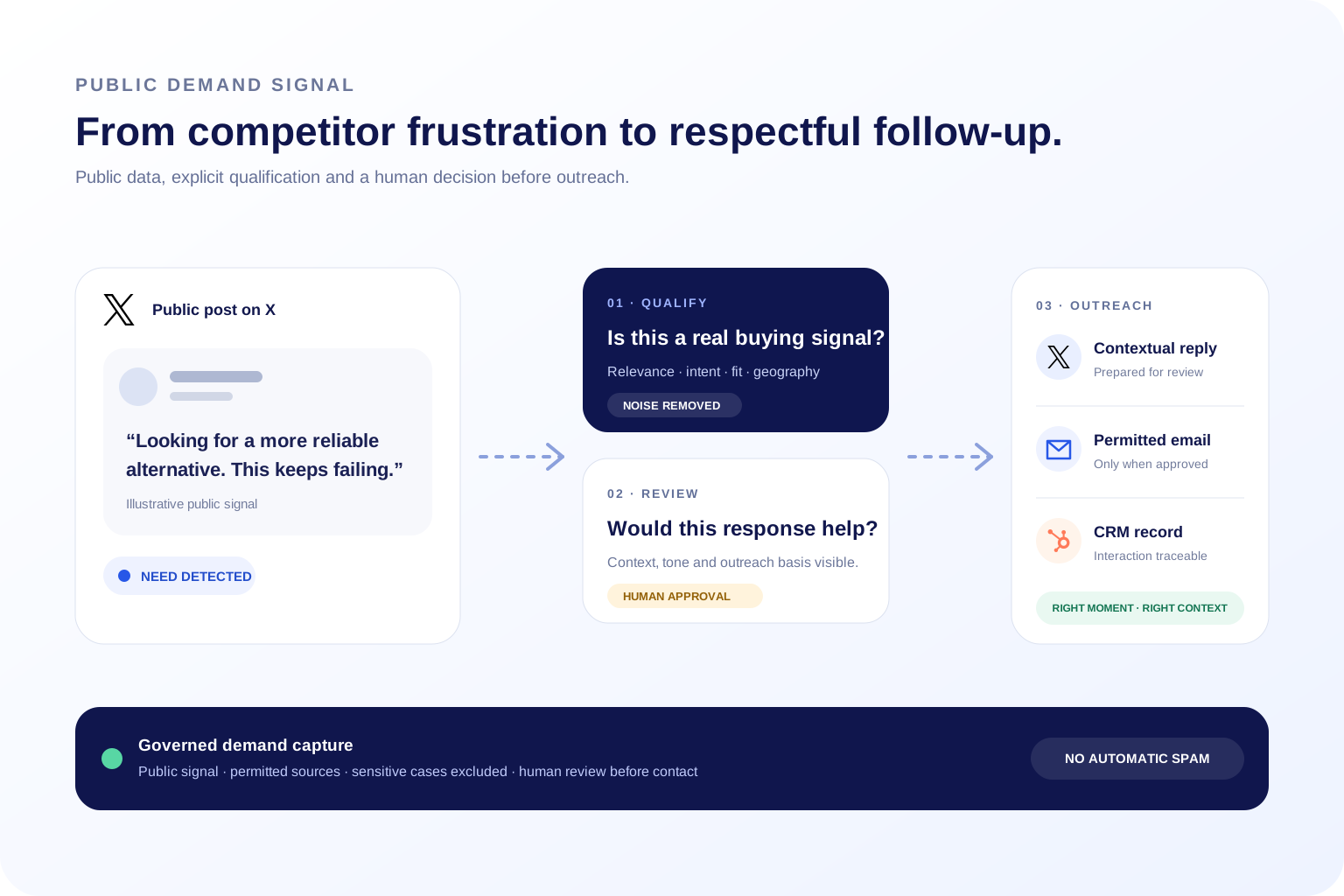
Turn competitor frustration into qualified demand

Detect relevant public complaints about competitors and prepare timely, respectful outreach while the need is active.
Read More
turn-competitor-frustration-into-qualified-demand

Business context

A public signal becomes an outreach opportunity only after relevance, intent, brand safety and the permitted contact path have been reviewed.

Prospective customers often describe a product failure, poor service or unmet need publicly on X. That moment can indicate real buying intent, but it moves quickly and is buried inside a much larger stream of irrelevant conversation.

Manual social listening finds only a small share of the opportunity and response quality varies by person. If the team replies too late, too generically or without context, the moment is lost and the outreach can feel intrusive.

The operating problem

Find genuine frustration, understand the need and respond before the buying window closes.

The system must distinguish a useful demand signal from jokes, news, bot activity, existing support conversations and sensitive personal situations. It also needs a lawful, brand-safe path from a public post to an X response and, only when permitted, a follow-up email.

What the demand-capture agent does

MATTE builds a governed listening and outreach workflow using approved public-data and platform access. The agent prepares context and responses; the business controls who is contacted and what is sent.

01 Listen for public demand signals

The workflow monitors approved competitor, category and problem terms on public X posts through permitted access.

02 Qualify the opportunity

The agent scores relevance, intent, geography and fit, then removes noise, sensitive situations and existing customer-support cases.

03 Prepare a useful response

The agent drafts a contextual X reply or direct outreach that addresses the stated problem without pretending to know more than the public post reveals.

04 Follow up with permission

If a business contact is lawfully available and outreach is permitted, the workflow prepares a relevant email and records the interaction in the CRM.

What changes for the business

Sales receives a smaller stream of timely, high-context opportunities from people already expressing an unmet need. Prospects receive a relevant response at the moment they are evaluating alternatives, not a generic campaign weeks later.

Measure it with: qualified public signals, time to approved response, X reply rate, permitted email response rate, sourced opportunities, opt-outs and complaints.

Controls and ownership

Automation has a boundary.

Use public information and permitted data sources only. Respect X platform rules, privacy law and anti-spam requirements. Do not collect private profile data, infer sensitive traits or send email unless the contact source and outreach basis are approved. Keep outbound messages behind human review until the operating model is proven.

Operating owner: Growth owns the target criteria and offer. Sales or community teams approve engagement, legal defines the outreach rules, and MATTE manages the agent and workflow controls.

Demand capture

Turn an approved brief into a launch-ready campaign

Standardize campaign structure, naming, UTMs, asset checks and approvals before work reaches the advertising platform.
Read More
turn-an-approved-brief-into-a-launch-ready-campaign

Business context

A structured build and QA workflow gives the accountable operator a clean, reviewable campaign before anything is published.

A media team launches campaigns across markets, platforms or business units. The strategy may be sound, but execution slows down because required inputs arrive in different formats and experienced operators repeat the same setup checks.

Launch delays reduce the time available to learn, while inconsistent naming and tracking create problems that survive long after the campaign is live. Senior operators become the manual quality-control layer for every brief.

The operating problem

The brief is approved, but the campaign still depends on a chain of manual handoffs.

Budgets, markets, audiences, assets, landing pages, naming and measurement inputs are spread across documents and messages. Missing information is found late, and platform setup is difficult to review before publishing.

What the campaign launch workflow does

MATTE builds the workflow around the team's current approval model. It prepares the work and exposes missing inputs; it does not remove the accountable operator.

01 Structure the brief

Required goals, markets, budgets, audiences, assets, landing pages and measurement inputs follow one intake model.

02 Apply operating rules

The workflow prepares naming, UTMs, campaign structure and platform-specific checks from approved standards.

03 Stop on missing inputs

Conflicts, missing assets and measurement gaps are returned to the responsible owner before platform setup.

04 Prepare for approval

A launch-ready plan or draft is presented with the exact objects, settings and checks the operator must review.

What changes for the business

Campaign setup becomes more consistent and easier to review. Teams reduce avoidable rework, preserve naming and measurement standards and keep senior operators focused on strategy and exceptions.

Measure it with: brief-to-launch time, first-pass approval rate, launch defects, naming or UTM exceptions and operator time spent on repeat setup.

Controls and ownership

Automation has a boundary.

Budget, audience, creative, destination and tracking settings remain visible before publish. The authorized operator approves the final platform action and can stop or revise the workflow at any stage.

Operating owner: Campaign operations owns the template and rules. Channel leads own platform approval, and requesters remain responsible for complete business inputs.

Campaign execution

Automate weekly reporting and exception alerts

Replace recurring exports and manual formatting with a governed report that separates signal from noise.
Read More
automate-weekly-reporting-and-exception-alerts

Business context

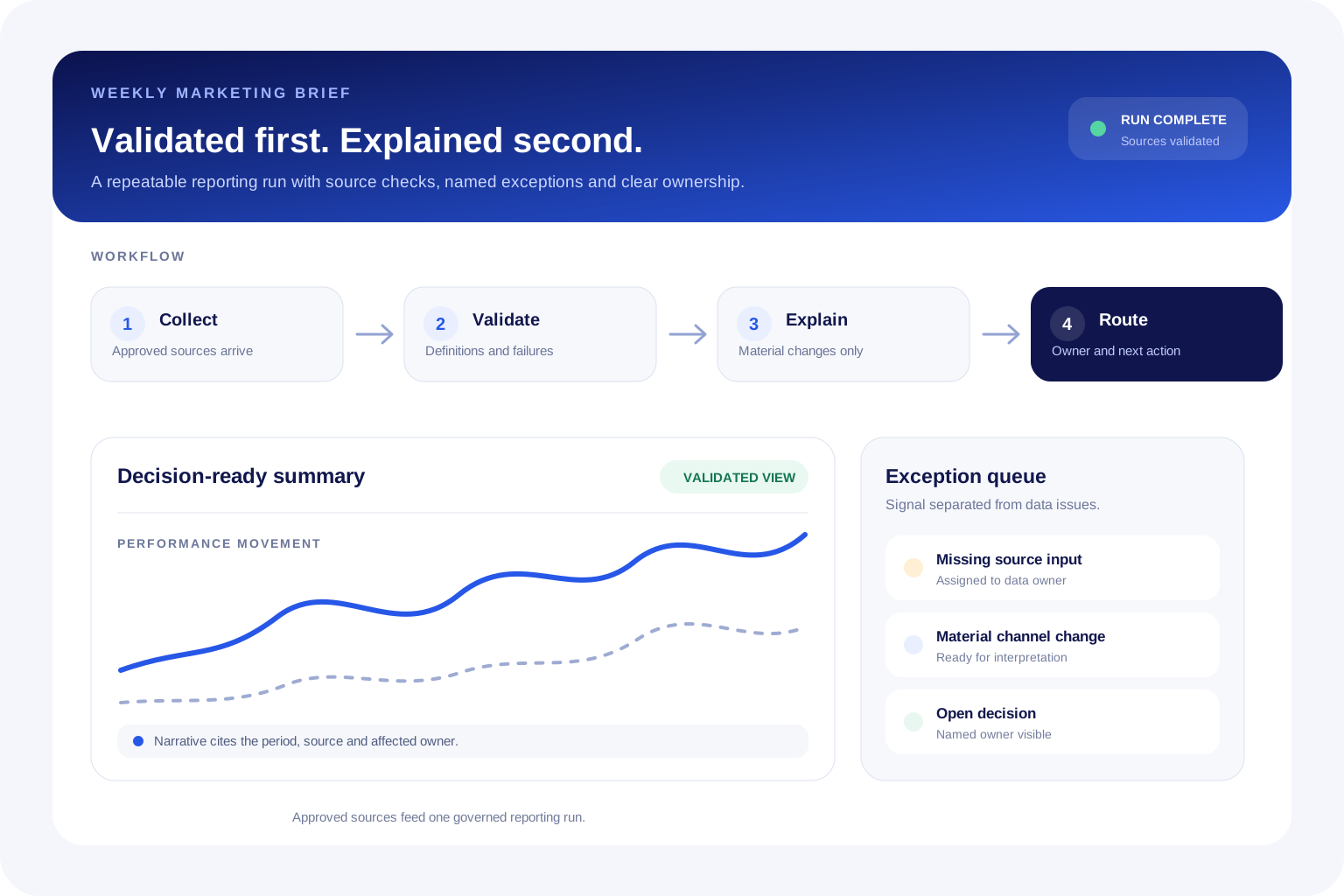
The reporting workflow validates source inputs before it explains performance and routes each material exception to a named owner.

A marketing team combines media, analytics, CRM or commerce data every week. Leaders want a short view of what changed, why it matters and who is responding.

Manual reporting consumes skilled time but still delivers late surprises. Because collection, validation and interpretation happen together, a broken input can be mistaken for a performance problem.

The operating problem

The same sources are exported, cleaned and summarized every week.

Reporting depends on manual steps and knowledge held by a small number of people. Missing inputs or unusual changes are often discovered late in the reporting cycle.

What the reporting workflow does

MATTE turns the current reporting process into a documented run with explicit data checks, business definitions and exception ownership.

01 Schedule collection

The approved data sources are retrieved on the agreed reporting schedule.

02 Apply shared definitions

Metrics, currencies, date rules and calculations follow one documented model.

03 Validate before interpretation

The workflow checks missing inputs, failed runs and unexpected variances before drafting commentary.

04 Route a decision-ready summary

Stakeholders receive the material changes, known data limitations, named owners and open actions.

What changes for the business

The team spends less time rebuilding the report and more time responding to it. Leaders receive consistent definitions and a visible distinction between a data-quality issue, a performance change and an action already in progress.

Measure it with: report preparation time, on-time delivery, failed data checks, manual corrections and time to assign material exceptions.

Controls and ownership

Automation has a boundary.

The workflow uses approved sources and documented calculations. Generated narrative should cite the underlying metric and period. Material decisions remain assigned to a named person.

Operating owner: Marketing operations owns the run. Channel owners validate interpretation, and leadership owns the decisions recorded in the report.

Reporting and intelligence

Turn a campaign audit into a decision-ready conversation

Ask what changed, inspect the evidence and review proposed actions without opening every advertising platform.
Read More
turn-a-campaign-audit-into-a-decision-ready-conversation

Business context

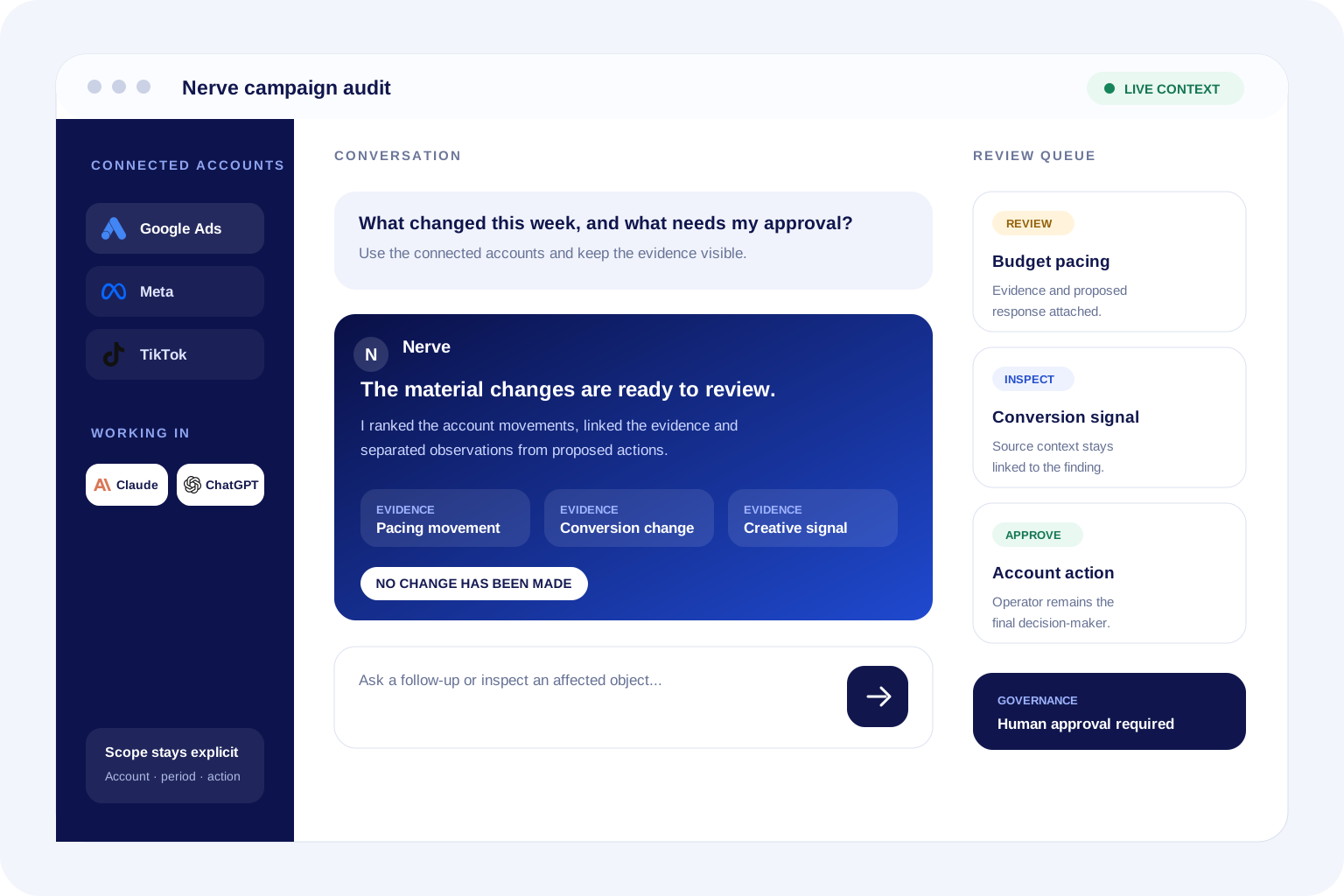
Nerve brings live account context, evidence and proposed actions into one reviewable conversation without hiding the approval step.

A performance team runs campaigns across several advertising platforms. It needs to explain changes in CPA, ROAS, pacing and creative performance while the account is still moving.

The cost is not only reporting time. Slow diagnosis means budget remains in weak areas longer, account knowledge stays with individual operators and recommendations arrive without a consistent evidence trail.

The operating problem

The team spends more time assembling the audit than deciding what to do.

Analysts spend time assembling account context before they can explain the largest performance changes. The handoff from finding an issue to proposing an action is slow and difficult to review.

How the Nerve audit works

Nerve uses the live context available through approved connections and returns the account evidence inside Claude or ChatGPT.

01 Ask one scoped question

The team names the accounts, date range, metrics and decision it needs to make.

02 Read the account context

Nerve retrieves current performance from the selected supported platforms and keeps the account scope explicit.

03 Explain material changes

The response ranks the movements that matter and shows the metrics, objects and comparison used.

04 Review the proposed response

The operator can question, revise or approve an action. No material change should be hidden inside the analysis.

What changes for the business

The audit becomes a working decision record. The team can move from a broad performance question to a ranked set of account actions while keeping judgment and approval with the responsible marketer.

Measure it with: audit completion time, issues found before reporting, time from finding to decision and share of proposed actions approved, revised or rejected.

Controls and ownership

Automation has a boundary.

Nerve is limited to the authorized accounts and supported actions. The user should see the evidence, affected objects and proposed values before deciding whether anything changes.

Operating owner: The performance lead defines the audit question. The account operator validates the recommendation and owns the final approval.

Campaign operations

Find mobile measurement breaks before they distort acquisition

Monitor events, postbacks, deep links and campaign mappings around the in-app actions that create value.
Read More
find-mobile-measurement-breaks-before-they-distort-acquisition

Business context

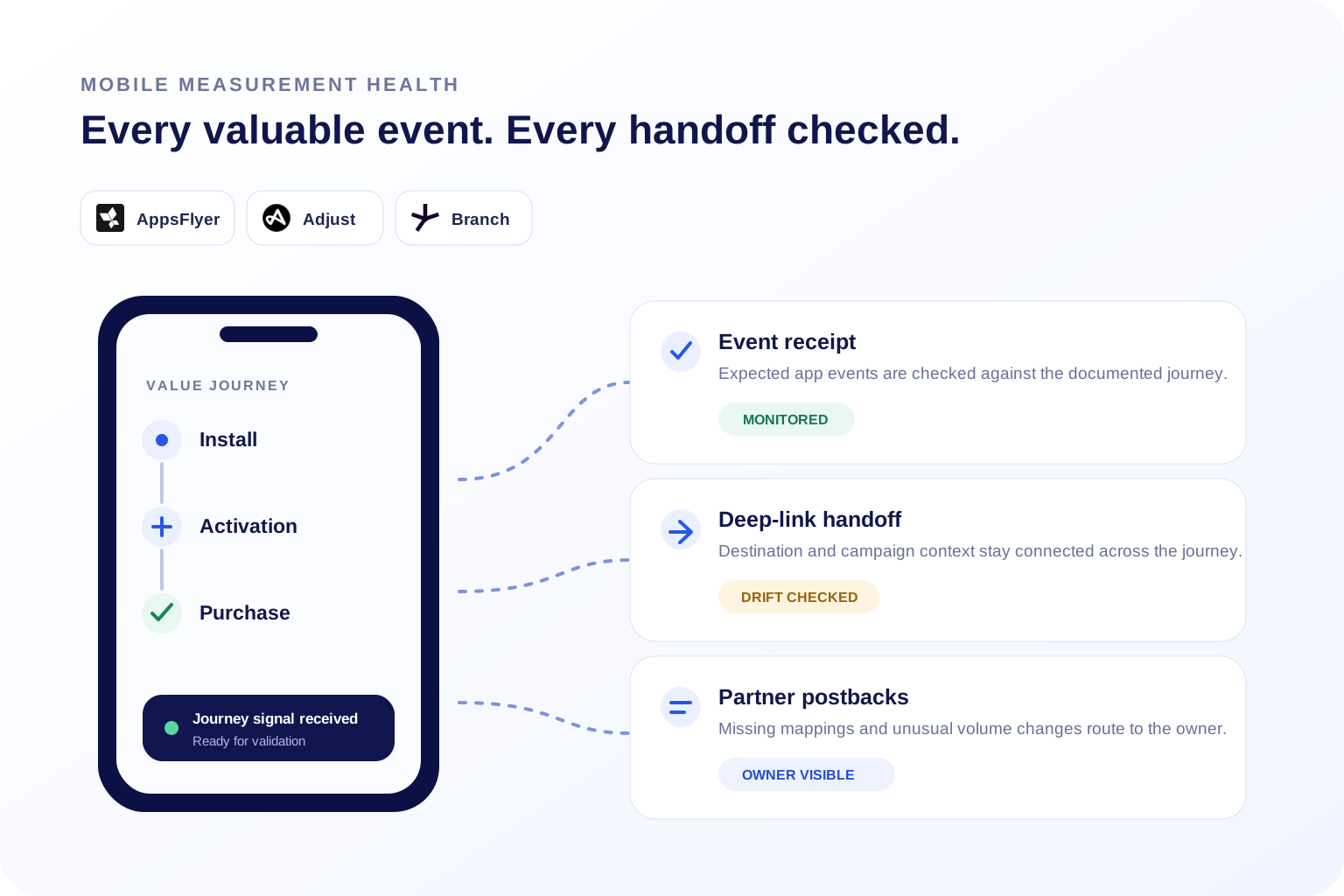
A monitored mobile journey makes missing events, broken deep links and partner-mapping drift visible before acquisition decisions are distorted.

A mobile growth team depends on an MMP, platform SDKs, deep links and privacy-era attribution. A small implementation change can silently alter what campaigns appear to be working.

When the measurement layer degrades, acquisition teams make budget decisions against incomplete events or misleading source data. The problem is often found only after performance reporting has already changed.

The operating problem

The stack is connected, but nobody can continuously check every handoff.

Install counts alone do not explain activation or purchase. Event naming, SDK behavior, partner postbacks, deep links and campaign mappings can drift independently across iOS, Android and media partners.

What the mobile measurement agent does

MATTE implements the MMP and event architecture, then can add a purpose-built agent to monitor the checks that matter to that specific app.

01 Define the valuable journey

The team identifies the activation, subscription, purchase or retention events that should govern acquisition decisions.

02 Map the expected handoffs

MATTE documents the SDK, MMP, deep-link, postback and media-platform behavior for each important event.

03 Monitor for drift

The agent checks missing events, unusual volume changes, broken mappings and data that falls outside expected ranges.

04 Route a diagnostic

The responsible owner receives the affected platform, event, release or campaign context and the next check to perform.

What changes for the business

Growth teams discover measurement issues closer to the moment they occur. Engineers receive a narrower diagnostic, while marketers can separate a real acquisition change from a broken signal before moving budget.

Measure it with: time to detect an event break, matched event rate, unresolved mapping exceptions, deep-link success and variance between MMP and backend events.

Controls and ownership

Automation has a boundary.

The agent monitors documented expectations and raises exceptions. It does not change production SDKs or attribution rules. Releases and platform changes stay inside the existing technical approval process.

Operating owner: Growth owns the business events. Product analytics or engineering owns implementation changes, and MATTE can own ongoing measurement QA.

Mobile measurement

Send qualified pipeline signals back to paid media

Help advertising platforms learn from sales-qualified opportunities and revenue, not every form submission.
Read More
send-qualified-pipeline-signals-back-to-paid-media

Business context

A sales-qualified outcome becomes a stronger marketing signal than a form submission alone.

A B2B or high-consideration business uses paid media to generate leads, but the outcome that matters happens later in the CRM. Sales decides which enquiries are real, which become opportunities and which produce revenue.

If media platforms only receive a form submission, they optimize toward the easiest lead to acquire. Marketing can reduce cost per lead while the sales team receives more low-quality demand.

The operating problem

Campaigns optimize toward lead volume while business value stays inside the CRM.

Advertising platforms treat every submitted form as equal. Marketing can report cost per lead, but it cannot consistently connect campaign decisions with sales-qualified opportunities and closed revenue.

What the revenue feedback workflow does

MATTE connects the CRM lifecycle to supported advertising platforms and builds the checks required to keep the feedback trustworthy.

01 Agree the value stages

Marketing and sales define the CRM changes that represent qualification, opportunity creation and revenue.

02 Match the marketing source

The workflow connects qualified outcomes to the campaign and click information available for the original lead.

03 Validate before sending

Records are checked for required fields, duplicate events, consent rules and unsupported mappings.

04 Return approved outcomes

Supported offline conversion events are sent to the relevant platforms and reconciled against the CRM.

What changes for the business

Campaign reporting moves from cost per lead to cost per qualified outcome. Media and sales can discuss the same funnel, and optimization has a better signal for the type of demand the business wants to create.

Measure it with: CRM-to-platform match rate, cost per qualified lead, cost per opportunity, pipeline value by campaign and failed feedback events.

Controls and ownership

Automation has a boundary.

Only agreed lifecycle stages are eligible for feedback. The data sent is limited to approved fields, failed records are logged and platform totals are reconciled with the CRM.

Operating owner: Revenue operations owns lifecycle definitions. Marketing operations owns the connection, and sales leadership validates the meaning of qualified stages.

Revenue attribution

Connect media spend to confirmed order revenue

Reconcile advertising conversions with orders, refunds and finance rules before paid-media return is reported.
Read More
connect-media-spend-to-confirmed-order-revenue

Business context

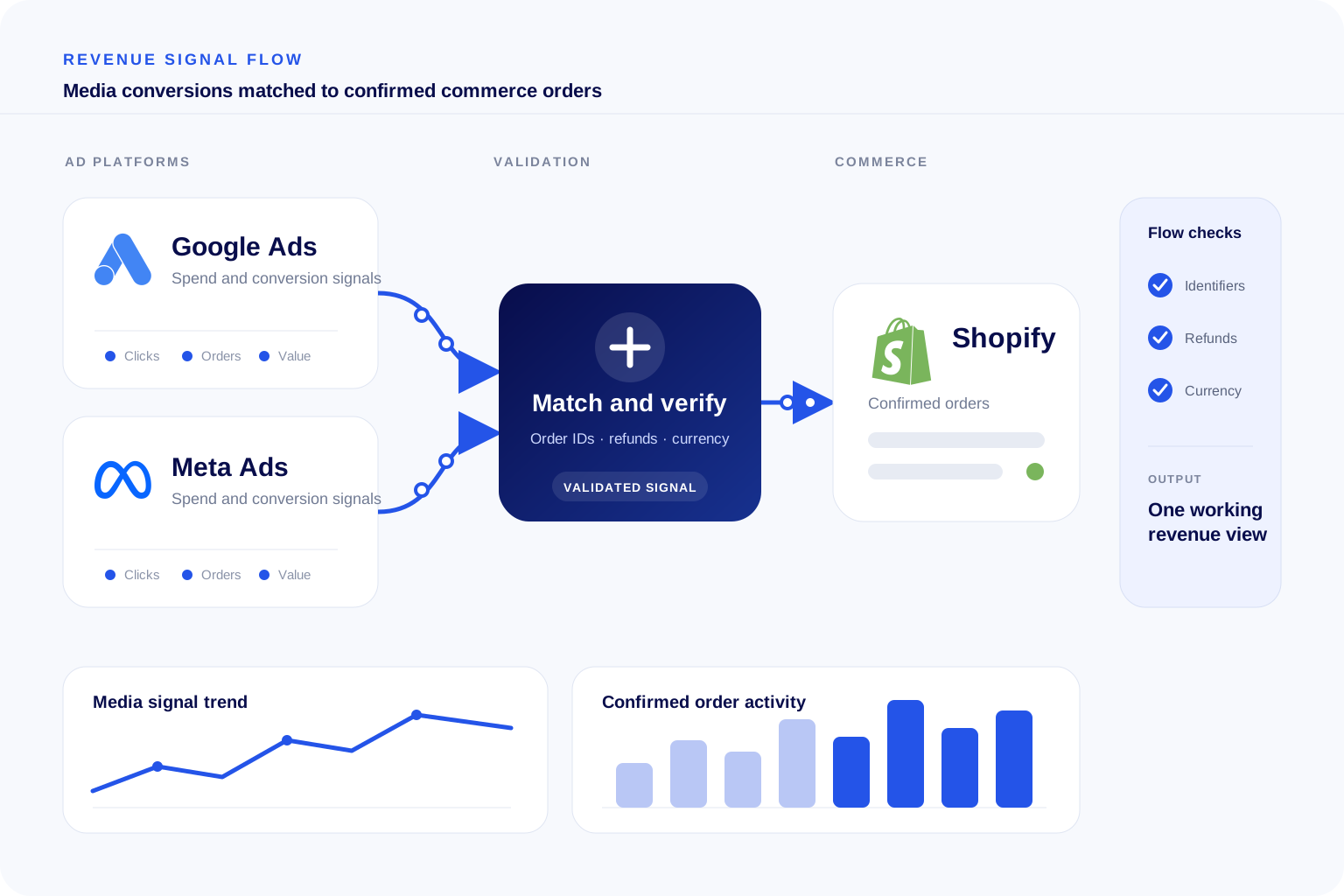
Google Ads and Meta signals are matched, checked and connected to confirmed Shopify orders before the revenue view is used for reporting.

A multi-market commerce business needs marketing and finance to work from the same revenue story. Advertising platforms report attributed purchases, while the order system holds the transactions the business actually recognizes.

When the two views are not reconciled, budget decisions rely on numbers finance cannot defend. Teams lose time debating which report is right and may scale activity against duplicated, cancelled or refunded orders.

The operating problem

The platforms report purchases, but the numbers do not match recognized revenue.

Duplicate events, refunds, currency conversion and different attribution rules create several versions of paid-media return. Marketing can optimize in-platform, but finance cannot reconcile those figures with confirmed orders.

What the revenue reconciliation workflow does

MATTE builds the data connections and the governed workflow around them. The automation repeats the calculation; the business still owns the revenue definition.

01 Define recognized revenue

Marketing and finance agree how orders, cancellations, refunds, taxes and currencies should be treated.

02 Connect the identifiers

Order IDs, campaign parameters and available click identifiers are mapped so records can be compared without double counting.

03 Run the reconciliation

The workflow compares platform conversions with confirmed commerce data and separates explainable attribution differences from tracking defects.

04 Publish one working view

Marketing receives the detail needed to optimize, while finance receives a traceable revenue calculation.

What changes for the business

Media decisions use a revenue view the business can explain. Discrepancies become a managed exception with an owner, rather than a recurring argument at the end of every reporting period.

Measure it with: share of orders matched to campaign inputs, unexplained revenue variance, reconciliation time and duplicate or invalid events found.

Controls and ownership

Automation has a boundary.

Finance approves the revenue rules and currency treatment. Marketing owns attribution use, while tracking changes follow a tested release and reconciliation process.

Operating owner: A marketing analytics owner runs the workflow. Finance validates the business calculation, and the media team uses the output for optimization.

Revenue attribution

Resolve the gap between Shopify revenue and GA4

Audit why Shopify and GA4 disagree, repair the data layer and build a dependable analytics view for marketing decisions.
Read More
resolve-the-gap-between-shopify-revenue-and-ga4

Business context

An eCommerce team sees one revenue number in Shopify and another in GA4. The difference changes by device, market, payment method and reporting period, so nobody knows which gap is expected and which one points to broken tracking.
When the discrepancy is unexplained, channel performance and conversion-rate decisions lose credibility. Marketing debates the numbers, analysts rebuild comparisons and leadership cannot tell whether a reported decline is commercial or technical.

The operating problem

Shopify records the transaction. GA4 explains the journey. The two systems are not supposed to be identical, but the gap must be understood.

Consent, attribution scope, payment redirects, duplicate purchase events, missing order IDs, refunds and currency handling can all create variance. A useful fix starts by separating normal platform differences from defects in the implementation.

How Nerve and MATTE close the measurement gap

Nerve supports a deep audit of the connected marketing and analytics context. MATTE then implements the custom data layer, event mapping and reporting controls required to correct the underlying system.

01 Quantify the discrepancy

Nerve and the analyst compare GA4 purchase events with Shopify orders by period, market, device, currency and available transaction identifiers.

02 Find the breakpoints

The audit checks consent behavior, checkout redirects, event firing, order IDs, duplicate purchases, refunds and attribution settings.

03 Implement the data layer

MATTE defines and deploys a custom commerce data layer with consistent events, parameters, transaction IDs and deduplication rules.

04 Build the working view

GA4 and the reporting dashboard show reconciled trends, known limitations and an exception check against Shopify revenue.

What changes for the business

The team gets a smaller, explainable discrepancy and a clearer boundary between Shopify revenue and GA4-attributed behavior. Marketing can use GA4 for journey and channel analysis without presenting it as the financial ledger.

Controls and ownership

Automation has a boundary.

Shopify remains the source for confirmed commerce transactions. GA4 remains the behavioral and attribution view. Data-layer changes are tested in a controlled environment and reconciled before release.

Operating owner: Marketing analytics owns the measurement model. The commerce or engineering team owns checkout changes, and MATTE can manage implementation, QA and ongoing monitoring.

Measurement and tracking
Matte Logo
Build Your Digital Workforce

Marketing And Technology Transformation Enablement. AI-powered solutions for modern marketing teams.

Contact:
hello@mattestudio.ai
LinkedIn
Book Discovery Call
Product
Nerve overviewFeaturesHow it worksConnectorsSecurity & privacyFor agenciesCustom AI agentsWorkflows
Solutions
Marketing AutomationData & TrackingAnalytics & AttributionMMP & Mobile AnalyticsPerformance OptimizationCustomer Data Platform
Resources
Help centreUse casesFAQsAbout MATTEIndustriesContact
Fast Ventures Logo Icon
MATTE is a subsidiary of Fast.
© 2026 MATTE. All rights reserved.
Privacy PolicyTerms of Service